Dell Hymes, one of the great American linguists, has died at the age of 82.
Hymes was one of the great influences on me as I did my field work on Gypsies. He was a linguist, an anthropologist, and never wavered from his devotion to empirical research as the foundation of the study of language, that is to say language in the context culture. In this he differed radically from the speculative, armchair "linguists" of today.
New Yorkers who understand French can subscribe to the French TV network TV 5 Monde and often get information that American media ignore. So tonight we heard about the ongoing totalitarian repression in China, something that should not have surprised me, but it did, just because we do not hear much about it. It's not a secret, there is quite a bit of information on the internet, yet for all the American public knows, "Laogai" may as well be a secret. There are millions -- perhaps as many as seven million -- prisoners in forced labor camps all over China. The Chinese bureaucratic term Laogai, "reform through labor," has now entered European languages to mean what it in fact is: brutal political and cultural repression There is a Laogai Research Foundation, a Laogai Museum in Washington (whose founder was Harry Wu), and a small band of human rights activists who take an interest. The prisoners are persons suspected of political or cultural or religious incorrectness, or in some cases are people who have committed criminal acts.
Could we perhaps get Ms. Clinton to think about Laogai the next time she hobnobs with Chinese Communist diplomats ? Or perhaps Mr. Obama might keep it mind at some diplomatic cocktail party, while sipping a cocktail with the Chinese ambassador ? He should be warned that a Chinese Communist diplomat in Berlin became furious and abusive after the Bundestag voted to condemn Laogai a couple of years ago.
Update, Nov. 17, 2009. Harry Wu to Obama: remember human rights on your visit !
Some six weeks ago, on Wednesday, September 23, Bill Moyers interviewed Judge Richard Goldstone on the PBS "Journal." The judge had just released his Report in which he had accused Israel (and, much less urgently, Hamas) of "war crimes" in the conduct of the 2008-9 Gaza war.
(It should be noted parenthetically that while Judge Goldstone has made numerous Recommendations to Israel for improving its behavior, his Report has nothing to recommend to Hamas, at least not to Hamas by name.)
As I listened to these two gentlemen in September, Moyers and Goldstone -- each more compassionate than the other, each more exuding compassion and good will than the other -- one accusation struck me as the most frightening of them all: it appears that Israel, in Goldstone's telling, had actually and deliberately shot prisoners to death whose hands were shackled behind them. The image stuck in my mind. No, I didn't believe that Jewish boys, even in the midst of war, would deliberately shoot captured and "shackled" men to death. And yet ... Jews, God knows, are no angels. Some are terribly cruel, not doubt. Could a terrible thing like this have happened ? I decided to look into the matter as much as I could. And I found out, as we shall see, that the best short answer to the question is that this alleged cruelty did not take place.
First of all, my memory played a trick on me. (I would suggest that others must have had the same experience.) I had remembered that, in the interview, Goldstone had actually used the words "shooting people whose hands were shackled behind them." It turns out that it wasn't Goldstone but Moyers who used the words, and that Goldstone -- shall I say merely ? -- that Goldstone assented to this telling of the story. Here (right below the video) is the relevant transcript:
BILL MOYERS: Your report, as you know, basically accuses Israel of waging war on the entire population of Gaza.
RICHARD GOLDSTONE: That's correct.
BILL MOYERS: I mean, there are allegations in here, some very tough allegations of Israeli soldiers shooting unarmed civilians who pose no threat, of shooting people whose hands were shackled behind them, of shooting two teenagers who'd been ordered off a tractor that they were driving, apparently carrying wounded civilians to a hospital, of homes, hundreds, maybe thousands of homes destroyed, left in rubble, of hospitals bombed. I mean there are some questions about one or two of your examples here, but it's a damning indictment of Israel's conduct in Gaza, right?
RICHARD GOLDSTONE: Well, it is outrageous, and there should have been an outrage. You know, the response has not been to deal with the substance of those allegations. I've really seen or read no detailed response in respect of the incidents on which we report.
Now, in his Report itself, the accusation by the Judge is very far from what it appears to be in this interview.
First of all, nowhere that I can see does the Report accuse Israeli soldiers of shooting "people" (i.e. plural) whose hands were shackled. I did not read every word of this 575-page report, but I looked at every use of the words "tied," "shackled," and "bound." There was only one instance that I could find in which the Report alleges that an Arab prisoner died while his hands were bound, the case of Iyad al-Samouni, which the Report takes up in paragraphs 739-742. These tell a confused story, completely based on Palestinian sources, about which Goldstone himself, it seems, had some doubts:
741. While the fire directed at Iyad al-Samouni [in shackles] could have been intended to incapacitate rather than to kill, by threatening his family members and friends with lethal fire, the Israeli armed forces ensured that he did not receive lifesaving medical help. They deliberately let him bleed to death.
So, it turns out, there was no cold-blooded deliberate killing of "people," or even of one person, as far as the Judge's actual Report goes.
Judge Goldstone's Report, relying on Palestinian and pro-Palestinian sources, paints the al-Samouni family as totally pacifist and innocent of terrorist activities. Other reports have claimed that this family has been involved in terrorist activities. On the whole, Judge Goldstone relies on biased sources, makes light of Hamas terror, and, overall, falls short of the blind justice that he is sworn to uphold. All that has been documented in the sources that I cite below. But in this case of "shackled hands" he has colluded with Bill Moyers in something that goes far beyond bias: a truly dreadful allegation, made orally on national TV, for which he could find no evidence in his own Report.
thegoldstonereport.com Dershowitz's detailed case against Goldstone Update 2/9/10: The Goldstone Report relied heavily on the work of extreme leftist groups in Israel. These groups were largely financed from abroad. Among their most important financial sources was the New York-based New Israel Fund, headed by the American-educated former member of Knesset, Naomi Chazan. Here is a full report of how NIF-financed groups contributed to the Goldstone bias.
Update 3/15/10: A very detailed response to Goldstone -- about 350 pages -- is now available from the Intelligence and Terrorism Information, an Israel NGO: "Hamas and the Terrorist Threat from Gaza."
Update 5/7/10: The Israeli press has uncovered sordid details about Goldstone's past, especially how, as an appellate judge for the apartheid regime, he routinely approved death sentences against Blacks.
I was 26 years old in 1952 when I devoted several weeks to a close study of Hannah Arendt's "Origins of Totalitarianism," which had appeared the previous year. I was a college graduate by then (from the then-famed CCNY), but otherwise innocent of the world of scholarship. "Origins" made a tremendous impression on me, as it did on many others at the time. Nobody was aware of, or would have cared if aware, her strange love life as the mistress of Heidegger.
First and perhaps foremost, "Origins" boldly proclaimed an equivalence between Stalin's Russia and Hitler's Germany. ( Since then specialists have pointed to the pitfalls in insisting on equivalence in history: two things are never exactly the same, and, it is now argued, the Soviet Union and Nazi Germany, while similar in many ways, were different in others.) To her great credit, Arendt went against the fashions of her time, a time when prevailing moods held the Soviet Union to be somehow on the Left and the Nazis on the Right. Of course, Arendt was neither the first nor the most incisive of the writers who insisted on the striking similarities between Soviet and Nazi domination.
The other noteworthy feature of Arendt's book, it struck me then and still strikes me now, was her observation that neither of the totalitarian movements could be explained by the self-interest of its supporters. The Marxist "materialist" explanations needed to be exposed. She was foremost in describing these movements as irrational and, in that sense, selfless. (Recent research, of course, has shown both self-interest and selfless "idealism" in these movements.)
Beyond these enduring aperçus, the book was full of what seemed to me erudite references to historical events and movements. Huge sections of the book were devoted to British and French history, and, I was led to believe, all this detail showed how profoundly educated the writer was, how deep a thinker. Now, more than half a century of commentaries by specialists, it is obvious to one and all that much if not all of Arendt's book place her into that category of know-all writers who start with having an idea (sometimes quite a good one) and then dress it up with whatever footnote references they can find to prove this idea. She had strong opinions, many of them valuable, but she had neither the inclination nor the scholarly habits to test these opinions.
A year or two after I studied her book, I enrolled in a graduate seminar with her at the New School. I thought then, and I think now, that she was the most arrogant person I ever met in my life, or at least tied for that position. She insisted that every one of her thoughts, no matter how fleeting or obviously ridiculous, be accepted as truth beyond any doubt.
Eleven years ago now, Walter Laqueur, in an indispensable article "The Arendt Cult: Hannah Arendt as Political Commentator," shows many instances of a petulant narcissism in her personal and professional life, and also demonstrates the irrationality of the admiration that her writings have inspired since her death. He also shows how prone she was to anti-Jewish prejudices (being Jewish herself was no inhibition).
So what is new ? Plenty. The Times Literary Supplement of October 9, 2009, carries a lengthy article entitled "Blame the victim. Hannah Arendt among the Nazis: the historian and her sources," by the distinguished historian Bernard Wasserstein (I have not been able to find an on-line version of this piece.) Much of Laqueur's older criticism is amplified here, with much new detail of Arendt's personal anti-Semitism, her haughty relations with others, the unscholarly nature of her "Origins of Totalitarianism:"
Her conception of the dynamics of historical change was confused, a mishmash of the structural, the social-psychological, and the conspiratorial. She was painfully ignorant of political economy, diplomacy, and military strategy and had little grasp or interest in the mechanics of the political process in the states about which she wrote. She snapped up unconsidered trifles of evidence and inflated them into richly coloured balloons of generalization.
But Wasserstein's most telling criticism comes when he details Arendt's ignorant use of anti-Semitic sources to reach her generalizations about the nature of the Jews. Sometimes she relies on such sources just carelessly, but more often she seems malicious. We all know, of course, that some years after writing her "Origins," Arendt repeatedly insisted that groups of Jews, particularly those incarcerated by the Nazis, collaborated with Nazis in ways that, presumably, she herself never would. She didn't much like Jews, and she didn't seem to care that her personal tastes and prejudices, and not only about Jews, ruined her objectivity as a writer.
UPDATE, March 13, 2010: read "Where Hannah Arendt Went Wrong," by the distinguished Israeli scholar Shlomo Avineri, in Haaretz Books of March 2010.
There is a new website, Understanding the Goldstone Report. I find the site marked by sobriety and restraint, and think that it is an important resource that you will wish to consult. The site's sponsors outline the conclusions that they have reached about the Report, as follows:
The Commission systematically favored witnesses and evidence put forward by anti-Israel advocates, and dismissed evidence and testimony that would undermine its case.
The commission relied extensively on mediating agencies, especially UN and NGOs, which have a documented hostility to Israel; the report reproduces earlier reports and claims from these agencies.
At the same time, the Commission inexplicably downplayed or ignored substantial evidence of Hamas’ commission of war crimes, crimes against humanity and crimes of terror, including specifically its victimization of the Palestinian population by its use of human shields, civilian dress for combatants, and combat use of protected objects like ambulances, hospitals and mosques.
The report contains numerous gratuitous digressions into issues beyond the purview of a fact-finding commission that are inaccurate and profoundly hostile to Israel and Jews.
If a person doesn't know, should he improvise an answer, or should he admit that he doesn't know ?
Here is an example from the field of Jewish studies, one in which I am not expert at all. It concerns a problem I have encountered in the Hebrew prayer book, and I have made an effort to consult a number of experts with whose help, and that of books they recommended, I found what I believe to be the correct answer.
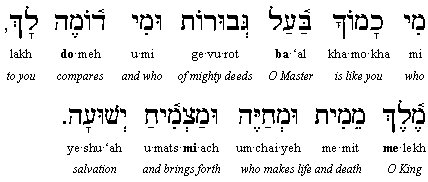
The problem arises from the daily Amidah prayer, part of which I reproduce here:
(Text, transliteration, and translation courtesy of a Christian group).
Now here is the problem. In the first line shown above, the prayer addresses G'd twice, each time asking, rhetorically, "who is like you ?," each time using a personal, second person pronoun-suffix. The first time the pronoun-suffix is used, " in "khamokha," G'd appears to be addressed as a male, but the second time, in "lakh," G'd appears to be a woman.
How is this apparent inconsistency to be explained ?
Ask people charged with being knowledgeable about such things, and you will get one of three answers:
1) I do not know.
2) Since G'd is neither male nor female, the writers of this prayer here indicate the gender neutrality of the deity by alternating the grammatical gender indicators. Some variation of this is the most commonly elicited answer. It happens to be ignorant, wrong, and unacceptable from one whose professional responsibility is to either know better or, at least, to understand the limitations of his own knowledge.
3) The correct answer, which I will not fully give away here, can be found by consulting a work on pausal forms in the history of the Hebrew language, for example pp. 96-98 of Gesenius' Hebrew Grammar, Second English Edition, 1910.
The problem with improvising knowledge about materials that come to us from the past is that this improvisation tends to be in the direction of what is now, currently, fashionable. In the case at hand, the improvised interpretation looks at the ancient text in the light of current, fashionable "gender fairness." Historians call this error one of anachronism.
Why is this kind of error so bad ? To put it most briefly, it robs us of understanding the text at hand. It suggests meanings to the prayers we utter that these prayers do not contain. In short, in this case, it reduces the actual Hebrew text to a mumbojumbo of phrases that are recited by rote without understanding.
For a stimulating discussion of gender in Jewish prayer, see the article by Lois C. Dubin
Rabbi Wolpe, whose mini-column I read every week in the Jewish Week, had a particularly important lesson last month. Here is an excerpt:
The Dubno Maggid told a story that should be learned by every Jewish child. He told of a father in a small Eastern European village who was walking his child to cheder, to school. Suddenly they heard a fanfare of trumpets and an elaborate coach pulled by beautiful horses rode down the road. The coach stopped right by them and out stepped a man wrapped in lush furs and dripping with jewels, dazzling the onlookers.
The father whispered to his son: “Take a good look, my child. For unless you learn and live Torah, that’s what you are going to look like!”
Learning Torah — and living Torah — can save us from the excesses that masquerade as meaning. How many of us are wise enough to whisper those words to our children — or heed them ourselves?
Rabbi David Wolpe is spiritual leader of Sinai Temple in Los Angeles. His latest book is “Why Faith Matters” (HarperOne).
 Dell Hymes, one of the great American linguists, has died at the age of 82.