Monday, October 19, 2009

Hannah Arendt

I was 26 years old in 1952 when I devoted several weeks to a close study of Hannah Arendt's "Origins of Totalitarianism," which had appeared the previous year. I was a college graduate by then (from the then-famed CCNY), but otherwise innocent of the world of scholarship. "Origins" made a tremendous impression on me, as it did on many others at the time. Nobody was aware of, or would have cared if aware, her strange love life as the mistress of Heidegger.

First and perhaps foremost, "Origins" boldly proclaimed an equivalence between Stalin's Russia and Hitler's Germany. ( Since then specialists have pointed to the pitfalls in insisting on equivalence in history: two things are never exactly the same, and, it is now argued, the Soviet Union and Nazi Germany, while similar in many ways, were different in others.) To her great credit, Arendt went against the fashions of her time, a time when prevailing moods held the Soviet Union to be somehow on the Left and the Nazis on the Right. Of course, Arendt was neither the first nor the most incisive of the writers who insisted on the striking similarities between Soviet and Nazi domination.

The other noteworthy feature of Arendt's book, it struck me then and still strikes me now, was her observation that neither of the totalitarian movements could be explained by the self-interest of its supporters. The Marxist "materialist" explanations needed to be exposed. She was foremost in describing these movements as irrational and, in that sense, selfless. (Recent research, of course, has shown both self-interest and selfless "idealism" in these movements.)

Beyond these enduring aperçus, the book was full of what seemed to me erudite references to historical events and movements. Huge sections of the book were devoted to British and French history, and, I was led to believe, all this detail showed how profoundly educated the writer was, how deep a thinker. Now, more than half a century of commentaries by specialists, it is obvious to one and all that much if not all of Arendt's book place her into that category of know-all writers who start with having an idea (sometimes quite a good one) and then dress it up with whatever footnote references they can find to prove this idea. She had strong opinions, many of them valuable, but she had neither the inclination nor the scholarly habits to test these opinions.

A year or two after I studied her book, I enrolled in a graduate seminar with her at the New School. I thought then, and I think now, that she was the most arrogant person I ever met in my life, or at least tied for that position. She insisted that every one of her thoughts, no matter how fleeting or obviously ridiculous, be accepted as truth beyond any doubt.

Eleven years ago now, Walter Laqueur, in an indispensable article "The Arendt Cult: Hannah Arendt as Political Commentator," shows many instances of a petulant narcissism in her personal and professional life, and also demonstrates the irrationality of the admiration that her writings have inspired since her death. He also shows how prone she was to anti-Jewish prejudices (being Jewish herself was no inhibition).

So what is new ? Plenty. The Times Literary Supplement of October 9, 2009, carries a lengthy article entitled "Blame the victim. Hannah Arendt among the Nazis: the historian and her sources," by the distinguished historian Bernard Wasserstein (I have not been able to find an on-line version of this piece.) Much of Laqueur's older criticism is amplified here, with much new detail of Arendt's personal anti-Semitism, her haughty relations with others, the unscholarly nature of her "Origins of Totalitarianism:"
Her conception of the dynamics of historical change was confused, a mishmash of the structural, the social-psychological, and the conspiratorial. She was painfully ignorant of political economy, diplomacy, and military strategy and had little grasp or interest in the mechanics of the political process in the states about which she wrote. She snapped up unconsidered trifles of evidence and inflated them into richly coloured balloons of generalization.
But Wasserstein's most telling criticism comes when he details Arendt's ignorant use of anti-Semitic sources to reach her generalizations about the nature of the Jews. Sometimes she relies on such sources just carelessly, but more often she seems malicious. We all know, of course, that some years after writing her "Origins," Arendt repeatedly insisted that groups of Jews, particularly those incarcerated by the Nazis, collaborated with Nazis in ways that, presumably, she herself never would. She didn't much like Jews, and she didn't seem to care that her personal tastes and prejudices, and not only about Jews, ruined her objectivity as a writer.

UPDATE, March 13, 2010: read "Where Hannah Arendt Went Wrong," by the distinguished Israeli scholar Shlomo Avineri, in Haaretz Books of March 2010.

UPDATE, Nov. 11, 2013:  read Gertrude Ezorsky's "Hannah Arendt Against the Facts." (1963), and Michael Ezra's "The Eichmann Polemics:  Hannah Arendt and Her Critics" (2007).

Thursday, October 15, 2009

A new website devoted to the "Goldstone Report"

There is a new website, Understanding the Goldstone Report. I find the site marked by sobriety and restraint, and think that it is an important resource that you will wish to consult. The site's sponsors outline the conclusions that they have reached about the Report, as follows:
  • The report violates international standards for inquries, including UN rules on fact-finding, replicating earlier UNHRC biased statements.
  • The Commission systematically favored witnesses and evidence put forward by anti-Israel advocates, and dismissed evidence and testimony that would undermine its case.
  • The commission relied extensively on mediating agencies, especially UN and NGOs, which have a documented hostility to Israel; the report reproduces earlier reports and claims from these agencies.
  • At the same time, the Commission inexplicably downplayed or ignored substantial evidence of Hamas’ commission of war crimes, crimes against humanity and crimes of terror, including specifically its victimization of the Palestinian population by its use of human shields, civilian dress for combatants, and combat use of protected objects like ambulances, hospitals and mosques.
  • The Commission openly denies a presumption of innocence to the Israelis accused of crimes (while honoring Hamas’ presumed innocence) and acknowledges that it made accusations of crimes without proof that would stand up in court.
  • The report contains numerous gratuitous digressions into issues beyond the purview of a fact-finding commission that are inaccurate and profoundly hostile to Israel and Jews.
  • The Commission distorted legal standards, imposing on Israel standards that reverse their generally understood and applied meaning, while ignoring important rules of international law that put the onus of responsibility on an organization as base, by Goldstone’s own standards, as Hamas.


Here is the testimony of Col. Richard Kemp of the UK Army, Ret.

Sunday, October 11, 2009

When the Authority Figures Improvise

If a person doesn't know, should he improvise an answer, or should he admit that he doesn't know ?

Here is an example from the field of Jewish studies, one in which I am not expert at all. It concerns a problem I have encountered in the Hebrew prayer book, and I have made an effort to consult a number of experts with whose help, and that of books they recommended, I found what I believe to be the correct answer.

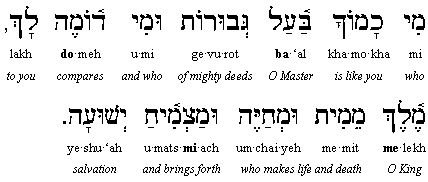
The problem arises from the daily Amidah prayer, part of which I reproduce here:


(Text, transliteration, and translation courtesy of a Christian group).

Now here is the problem. In the first line shown above, the prayer addresses G'd twice, each time asking, rhetorically, "who is like you ?," each time using a personal, second person pronoun-suffix. The first time the pronoun-suffix is used, " in "khamokha," G'd appears to be addressed as a male, but the second time, in "lakh," G'd appears to be a woman.

How is this apparent inconsistency to be explained ?

Ask people charged with being knowledgeable about such things, and you will get one of three answers:

1) I do not know.

2) Since G'd is neither male nor female, the writers of this prayer here indicate the gender neutrality of the deity by alternating the grammatical gender indicators. Some variation of this is the most commonly elicited answer. It happens to be ignorant, wrong, and unacceptable from one whose professional responsibility is to either know better or, at least, to understand the limitations of his own knowledge.

3) The correct answer, which I will not fully give away here, can be found by consulting a work on pausal forms in the history of the Hebrew language, for example pp. 96-98 of Gesenius' Hebrew Grammar, Second English Edition, 1910.

The problem with improvising knowledge about materials that come to us from the past is that this improvisation tends to be in the direction of what is now, currently, fashionable. In the case at hand, the improvised interpretation looks at the ancient text in the light of current, fashionable "gender fairness." Historians call this error one of anachronism.

Why is this kind of error so bad ? To put it most briefly, it robs us of understanding the text at hand. It suggests meanings to the prayers we utter that these prayers do not contain. In short, in this case, it reduces the actual Hebrew text to a mumbojumbo of phrases that are recited by rote without understanding.

For a stimulating discussion of gender in Jewish prayer, see the article by Lois C. Dubin

Thursday, October 8, 2009

A Lesson from the Torah

Rabbi Wolpe, whose mini-column I read every week in the Jewish Week, had a particularly important lesson last month. Here is an excerpt:
The Dubno Maggid told a story that should be learned by every Jewish child. He told of a father in a small Eastern European village who was walking his child to cheder, to school. Suddenly they heard a fanfare of trumpets and an elaborate coach pulled by beautiful horses rode down the road. The coach stopped right by them and out stepped a man wrapped in lush furs and dripping with jewels, dazzling the onlookers.

The father whispered to his son: “Take a good look, my child. For unless you learn and live Torah, that’s what you are going to look like!”

Learning Torah — and living Torah — can save us from the excesses that masquerade as meaning. How many of us are wise enough to whisper those words to our children — or heed them ourselves?

Rabbi David Wolpe is spiritual leader of Sinai Temple in Los Angeles. His latest book is “Why Faith Matters” (HarperOne).

From: Jewish Week, Sept. 15, 2009

Saturday, August 15, 2009

Peace Now -- Peace in Our Time

Mr. Neville Chamberlain (center), Pg. Joachim von Ribbentrop (left), Führer Adolf Hitler, Sept. 28, 1938


History has not been kind to Mr. Chamberlain. The agreement with Hitler that he so proudly displayed on his return to Britain proved to be worthless. In a way, mutatis mutandis, Chamberlain was the Barack Obama of his time: confrontation is noxious and dangerous, he believed, negotiation is the only reasonable way to go. Of course the situation then was not the situation today, and today's foes are not identical to the foes of 1938; Obama's path today may yet prove to be the wise one that his admirers hope it will be.

But there is something eerily similar between then and now. Hitler's Nazi movement made an appeal to dark human passions that sweet reason could not assuage. Sweet reason -- can't we all just get along ? -- does not solve all issues, pace Chamberlain, Obama, and the bien-pensant liberals of our day. Today, I fear, our (mostly liberal) chattering classes, so intent on getting on with negotiation and avoiding confrontation, simply fail to notice that Islamism, in this respect not unlike the Nazism of yore, appeals to passions that are not provided for by rational-man images of bourgeois society.

Today's New York Times tells us that "at least 6 die as Islamists clash with Hamas" in the Gaza territory. The story of bloody mayhem, members of one Islamicist faction killing those of another, is buried on page 7, with the front page taken up by more important news: "retailers see slowing sales in key season," "idle Iraqi date farms show decline in economy," a shooting in Harlem, etc. But the violence of Palestinian Islamicists against one another gets swept under a page-seven rug. And New York Times's readers are spared a confrontation with uncomfortable reality.

The sweet-reason, can't-we-all-just-get-along movement in Israel is called Peace Now, and is promoted by left-wing parties like Meretz. Peace Now was founded some thirty years ago with the proposition that if only Israel were nicer to the Arabs, the Arabs, in turn, would be nicer to Israel. If Peace Now has a guiding principle, it is that radical, uncompromising Islamicism is to be strictly ignored. But, alas, while Israel has tried to be as nice as possible to the Arabs (most notably at Camp David in 2000 and at Taba in 2001), more or less following Peace Now prescriptions, there have been no positive results, peace now being more elusive than ever. Consequently, as explained by Carlo Strenger in a recent issue of Haaretz, Peace Now has virtually disappeared from Israeli politics.


Update on the intra-Islamist violence in Gaza (Haaretz, 8/15/09):
Dr. Moaiya Hassanain of the Palestinian Health Ministry in Gaza said 24 people were killed, including six Hamas police officers and an 11-year-old girl. At least 150 people were wounded, he said.


Thursday, August 6, 2009

When Everything is Black or White: Caldwell's book on Islam in Europe

In the Photoshop program for editing photographs, there is a facility by which one can increase or decrease the contrast of an image. I took a black-and-white portrait of my youngest granddaughter, and then dialed up the contrast to a maximum. The result is a picture, interesting in itself, but lacking all nuance of shading. Everything is black or white.

I thought of this ability to rev up contrast, with its result of utter distortion, as I read the book "Reflections on the Revolution in Europe" by Christopher Caldwell. Caldwell is upset by the large Muslim populations in Europe, and, indeed, there are real enough problems. But Caldwell sees everything in black and white. The Muslim populations, he claims, have not assimilated, AT ALL, to European culture. Caldwell is not a scholar, and his use of statistics (and other data) is tendentious and naive. I think that he does point to things we need to worry about, but his highly contrasty portrait will not help us think about the problem intelligently.

I have reviewed this book for Amazon.

Wednesday, July 22, 2009

Sotomayor: My Mom Doesn't Get It

Celina Sotomayor (AP)

The Senate confirmation hearings of Judge Sonia Sotomayor for the Supreme Court were bland and brought little to surprise anyone. Certainly, if I were a US Senator I would vote to confirm. That said, I must report my unease at her response, which I heard on CSPAN, to comedian Al Franken's question: why do you want this job. I have so far been unable to obtain the transcript of her response, but the NY Times blog The Caucus gives an account very close to what I remember:

Franken and the Job | 12:16 p.m. Why does the judge want to join the Supreme Court? asks Senator Al Franken, Democrat of Minnesota.

This prompts a lengthy story from the judge, in which her mother, Celina, and her stepfather, Omar, play a role. As she tells it, her mother couldn’t understand why she would take a job that involved a sizable pay cut from her lawyer’s work in private practice, would limit her foreign travel and would prohibit her from having friends who might come before her in court. Her stepfather apparently, at the end, turned to his wife, and said in Spanish, “You know you daughter and her stuff with public service.”

And the judge continued: “That really has always been the answer given, who I am, my love of the law, my sense of importance about the rule of law, how central it is to the functioning of our society …” Those have always created a passion in her, she added. “I can’t think of any greater service I could give to the country.”

As I recall the Judge, she said "all this was in Spanish," wink wink, suggesting, when taken together with her verbiage here, an unpleasant condescension toward her mother --how cute, my old mom, but alas lacking in the sophistication of all those Eastern schools where I learned my selfless morality. There is no doubt that the judge has great affection for her mother, whom she has praised repeatedly in the public record. But condescension nevertheless.

As it happens, Celina Sotomayor achieved graduation from college in New York and became a Registered Nurse, passing her RN boards in English, so the Judge's condescension is doubly misplaced.

Doubly: even if her mother had not had American higher education, or English proficiency, it is a bit outrageous to suggest that our immigrant parents and grandparents cannot be trusted with making ethical decisions as good as ours.